Halloween is one of my favorite holidays. Here are some simple tips that should help keep it safe and fun for everyone.
1. When planning your children’s trick-or-treating route, stick to residential neighborhoods. Try to avoid deserted industrial areas, construction sites, and toxic waste dumps.
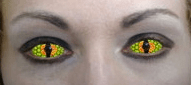
2. Novelty contact lenses can add a new dimension to a Halloween costume. Please get yours from a licensed eye care professional; resist the temptation to create your own using an empty plastic water bottle, a razor blade, and a set of colored markers. Continue reading “Halloween Safety Tips”→
As a public service, I offer these suggestions to aspiring murder mystery writers who want to improve their work.
1. If at all possible, have the murder occur on Halloween. Halloween is the best day of the year to dispose of a body — you can walk around in blood-stained clothes, carrying as many severed body parts as you want, and people will just think you have a really cool costume. Of course, there’s always the possibility that, once people hear the news that a murder has occurred, they’ll have second thoughts about the costume they saw — but that’s okay, because they won’t know that you were the person wearing it. Remember, on Halloween, you can wear a mask. Continue reading “How to Write the Perfect Mystery Novel”→
It’s 1965, and things are looking pretty grim at Sterling Cooper Draper Pryce (SCDP), the fictional advertising agency featured on Mad Men. Partner Pete Campbell has just sabotaged a lucrative new contract with North American Aviation in order to avoid a background check that would reveal secrets that might result in jail time for senior partner Don Draper. Even worse, they’re about to lose their largest client, Lucky Strike cigarettes. Can the agency survive? I think it can, with a little help from some of its contemporaries: this series of five crossover episodes with 1960s-era TV shows should put SCDP back on track. Continue reading “Can Mad Men’s Ad Agency Survive? Yes, With a Little Help From Some Of Its Contemporaries”→
When I heard that General Motors was testing a new feature that allows drivers to post Facebook status messages while driving, I couldn’t wait to try it out. So I called GM, explained that I have a blog with almost a dozen regular readers, and asked if they’d let me try the system out for a few days in exchange for some free publicity. Naturally, they jumped at this opportunity and offered me a 48-hour test drive.
Tuesday, after work: I stop by the dealership to pick up my vehicle, a Chevy Impala with the prototype social networking software installed. After programming in my login information (a tedious process, but one that only needs to be done once) and getting a brief tutorial on how to use the system, I’m all set. As soon as I pull out of the dealership, I dictate my first (admittedly unimaginative) update: “Hi! This is my first Facebook update from my car”.
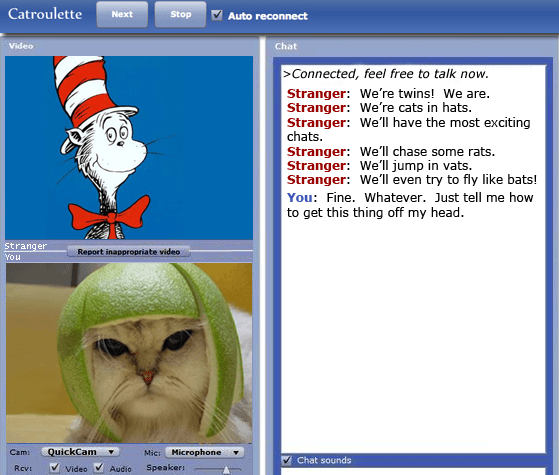
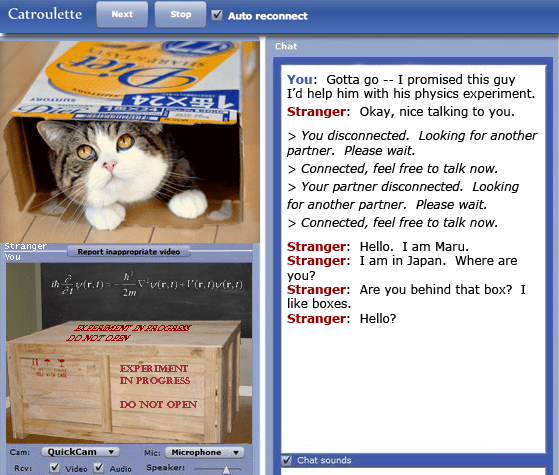
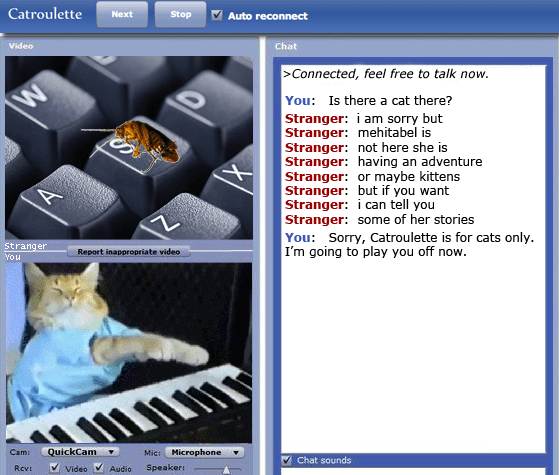
By now you’ve probably heard of Chatroulette, the website that pairs people up for anonymous online video chats with random strangers. Here are some screenshots from a similar but lesser-known service catering exclusively to cats.
I’m actually not the first person to think of the name “Catroulette” — it’s also the name of a cute site that collects images from (apparently) real Chatroulette sessions involving cats. But the best use of the name by far goes to this cat adoption site in Belgium.
Recently, there have been a few things I’ve wanted to say to some of my Facebook friends but haven’t been able to, because of technical or other issues with the Facebook framework. Here are some examples.
“I’m happy for you, but I don’t care who else is happy for you”.This happens to me all the time — someone posts a Facebook update announcing a pregnancy, birth, graduation, or other news, and I foolishly click the “like” button or add a “Congrats!” comment. And then, for the rest of the day, I get a constant barrage of Facebook notifications. I click on each one expecting lavish praise for my latest astute observation that my car is dirty or that bees exist, only to have my hopes dashed when I realize it’s yet another person adding a “Congrats!” comment of their own. Continue reading “Sentiments I’m Incapable of Expressing on Facebook”→
This is a departure from what I usually post here. The tagline for this blog is “please don’t take anything you read here seriously”, but I hope people actually will take this seriously.
I’m a cat person. I have two cats; when I make travel plans, the first person I call is my cat-sitter, and when I return home, the thing I look forward to most is being greeted by my cats. I’ve learned how to type with a cat between me and the keyboard. While writing this post, I’ve stopped a couple times to do important cat-related things (like throwing toys across the floor so one cat can chase them, or picking up a cat and carrying him over to the wall so he can sniff the light switches). In other words, the only reason I’m not a card-carrying crazy cat lady is that, as far as I know, there is no card-issuing crazy cat lady organization. Continue reading “Dear Cat-Hater Haters: Please Stop. You’re Not Helping.”→
By now, you’ve probably heard that federal prosecutors have decided not to press charges in the Pennsylvania high school laptop spying case. I thought it might be helpful if I explained some of the legal issues involved — but first, I should probably list my qualifications as an expert. Continue reading “Arbitrary and Capricious”→
P vs. NP is one of the most famous unsolved problems in math. Recently, mathematician Vinay Deolalikar circulated a paper that contained a possible solution to that problem. There’s been lots of discussion on the Internet about this paper; surprisingly, though, the companion video series has been largely ignored.
Maru
In Vinay and Maru Prove that P ≠ NP, Deolalikar presents the material from his paper with the assistance of Maru, who is possibly the most entertaining cat on YouTube. Each episode features video imagery of Maru with narration by Deolalikar. In Episode 1, Deolalikar defines what P ≠ NP means — basically, that the solutions to some problems are hard to find but easy to verify — while Maru interacts with a large cardboard box. Finding a way into the box is a difficult problem for Maru; eventually, he solves it and goes on to demonstrate (repeatedly) that verifying the solution is easy. Of course, the fact that Maru found the initial problem difficult doesn’t prove anything; it’s possible that someone could discover a simpler box-entry-finding algorithm tomorrow. Episode 1 gets two thumbs up from me — the narration is clear and informative, and Maru’s performance is outstanding. Continue reading “Video Review: Vinay and Maru Prove that P ≠ NP”→
Now that Proposition 8 has been overturned, will the California constitution require all public schools in the state to teach gay marriage?
Yes.
I don’t understand. Schools weren’t required to do that before the election. How does leaving the Constitution unchanged impose a new requirement on them?
Many people are confused by this, but the explanation is really quite simple. In 2004, Californians passed Proposition 59, which added Article 1, Section 3(b) to the California Constitution. Although this addition appears at first glance to concern itself only with public access to government meetings and records, legal scholars discovered in 2008 that language requiring schools to teach gay marriage had been concealed in Section 3(b), using a process known as steganography. Continue reading “Frequently Asked Questions About California’s Proposition 8”→

 2. Novelty contact lenses can add a new dimension to a Halloween costume. Please get yours from a licensed eye care professional; resist the temptation to create your own using an empty plastic water bottle, a razor blade, and a set of colored markers.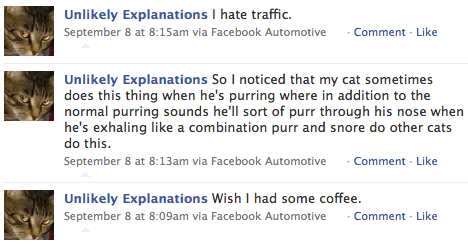

 This happens to me all the time — someone posts a Facebook update announcing a pregnancy, birth, graduation, or other news, and I foolishly click the “like” button or add a “Congrats!” comment. And then, for the rest of the day, I get a constant barrage of Facebook notifications. I click on each one expecting lavish praise for my latest astute observation that my car is dirty or that bees exist, only to have my hopes dashed when I realize it’s yet another person adding a “Congrats!” comment of their own.

 Unlikely Explanations